

Upcoming Seminars
CeNS Colloquium
Thursday, May 02, 15:30h
Prof. Andrew Mackenzie, Max Planck Institute for Chemical Physics of Solids Dresden
Using uniaxial pressure to both tune and probe quantum materials
Successful Science Writing
Future Events
CeNS Retreat Kleinwalsertal
May 13-16, 2024 more...
6th Functional DNA Nanotechnology Workshop 2024
June 26, 2024 - June 28, 2024 more...
Welcome to the Center for NanoScience

The Center for NanoScience (CeNS) was founded in 1998 at the Ludwig-Maximilians-University (LMU) Munich. The mission of CeNS is to promote and coordinate interdisciplinary research in the field of nanoscience in the Munich area. CeNS is an association of junior and senior scientists from basic research and industry and is conceived as a network, joining people from various institutions (LMU, TU Munich, University of Augsburg and others).
Nano Innovation Award 2024
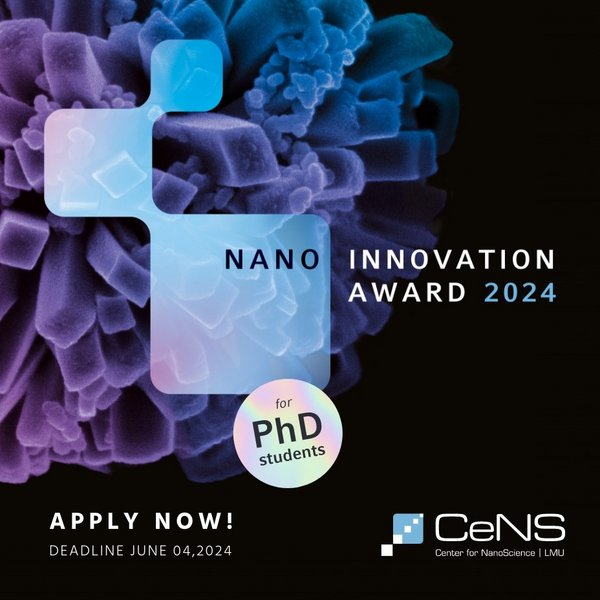
CeNS invites applications for the Nano Innovation Award 2024. The prize will honor PhD students for excellent nanoscience research performed in Bavaria. The prize money is donated by the CeNS spin-offs attocube systems, Nanion Technologies, and NanoTemper Technologies. Application deadline: June 4, 2024. more...
A network exploring the nanoworld

CeNS consolidates research activities at the nanometer scale from the areas of physics, biophysics, chemistry, biochemistry, and medicine. The network promotes the mutual understanding and collaboration between researchers from these different disciplines by joint seminars, workshops, and schools which are organized by CeNS. Professors, junior group leaders, PostDocs, and graduate students interact with each other within this lively network, exchanging scientific ideas and establishing new research collaborations.
Interdisciplinary Education

CeNS offers a comprehensive educational program to PhD and Diploma students. Workshops, seminars, colloquia and lecture series are organized on a regular basis throughout the whole year. The topics presented by internationally renowned speakers cover the broad spectrum of nanosciences and nanobiosciences. International exchange programs and soft-skills workshops complete the interdisciplinary program. The students are incited to suggest workshop topics and organize scientific events on their own and are strongly encouraged to invite interesting speakers to seminars and workshops.
Transfer to Industry
The creative and unorthodox atmosphere within CeNS efficiently helped to create concepts for and incubate young nano-technological companies: the spin-off companies attocube systems, baseclick, ChromoTek, ethris, Gattaquant, GNA biosolutions, ibidi, Nanion Technologies, Nanotools, NanoTemper and Neaspec currently employ about 500 mostly young scientists and technologists, working primarily on nano- and nanobiotechnological tasks. CeNS offers a creative scientific environment which is essential for these start-up companies, acts as a training facility with over 100 graduates per year, and provides the spin-offs with well-trained and particularly motivated scientists and technologists. More...
International Cooperation

In addition to the numerous research collaborations of individual CeNS members with scientists from all around the world, CeNS has established a growing number of cooperations with international nanoscience institutes. Exchange of doctoral researchers (e.g. Junior Nanotech Network) and Master's students as well as joint workshops (e.g. Workshop on Global Challenges - Opportunities for Nanotechnology) are the means by which these cooperations are realized. More...
The Fertile Soil

On the fertile soil of CeNS new multidisciplinary research groups have been established such as the Clusters of Excellence e-conversion and MCQST, the SFB 1032 "Nanoagents for spatiotemporal control of molecular and cellular reactions" of the German research council (DFG) as well as many interdisciplinary research projects supported by the BMBF, the DFG, the Volkswagen Foundation, and the European Union.
Heat flows the secret to order in prebiotic molecular kitchen
LMU biophysicists have demonstrated how heat flows through rock fissures could have created the more …
Self-assembly of complex systems: hexagonal building blocks are better
Physicists at LMU Munich show that the shape of components is a major determinant of how quickly more …
New synapse type discovered by spatial proteomics
Researchers led by Ralf Jungmann have developed a super-resolution imaging method (SUM-PAINT) to more …
Further News more ...
Heat flows enrich prebiotic building blocks and enhance their reactivity.
Thomas Matreux, Paula Aikkila, Bettina Scheu, Dieter Braun & Christof B. Mast. Nature 628, 110–116
Design principles for fast and efficient self-assembly processes
Florian M. Gartner and Erwin Frey. Physical Review X
Further Selected Publications
more ...